
Suno V6 has arrived, but the argument about whether it sounds better misses a more useful question: does the track do what you need it to do? A bigger mix is not much help when the singer changes character, the chorus loses its hook or the release package is unfinished.
This guide separates the launch facts from early creator reactions, then turns those reactions into a practical workflow for finishing, releasing and selling your music.
Preparing a Suno track for release? Start with Undetectr’s watermark-removal workflow. Process a copy of your chosen export, listen through the result and prepare your final delivery file.
Want fans to buy your music? Sell your AI music direct to your fans on Played.fm. Build a storefront around a finished track, EP or album, set a clear offer and give listeners a direct purchase destination. Played welcomes AI-made music when you have the necessary commercial rights; it is a direct-sales route, not your Spotify distributor.
A finished Suno track needs a clear path from generation to release.
Key takeaways
- Suno announced V6 on September 9, 2026. A 20-day research window includes pre-launch speculation, not 20 days of public V6 testing.
- Early reactions include both improved sound and complaints about vocal character, arrangement and prompt control. Judge those separately.
- The download-policy change and the model launch are different events. Check the current allowance before planning an export-heavy project.
- Audio processing can be part of release preparation. It does not supply missing permissions or guarantee distributor approval.
- Spotify delivery and direct fan sales serve different purposes. You can plan for both without confusing them.
In this guide
- What actually changed with Suno V6?
- What are creators saying?
- How to evaluate your own V6 track
- How to release Suno music: watermark removal with Undetectr
- Preparing for Spotify and distributor review
- Sell your AI music direct to your fans on Played.fm
- A practical release checklist
- Frequently asked questions
What actually changed with Suno V6?
There are three dates to keep straight. Our research looks back from September 11 to August 22. Suno's download changes took effect on September 3. The official V6 announcement followed on September 9. A frustrated post written between those last two dates may be about downloads or expectations rather than experience with the released model.
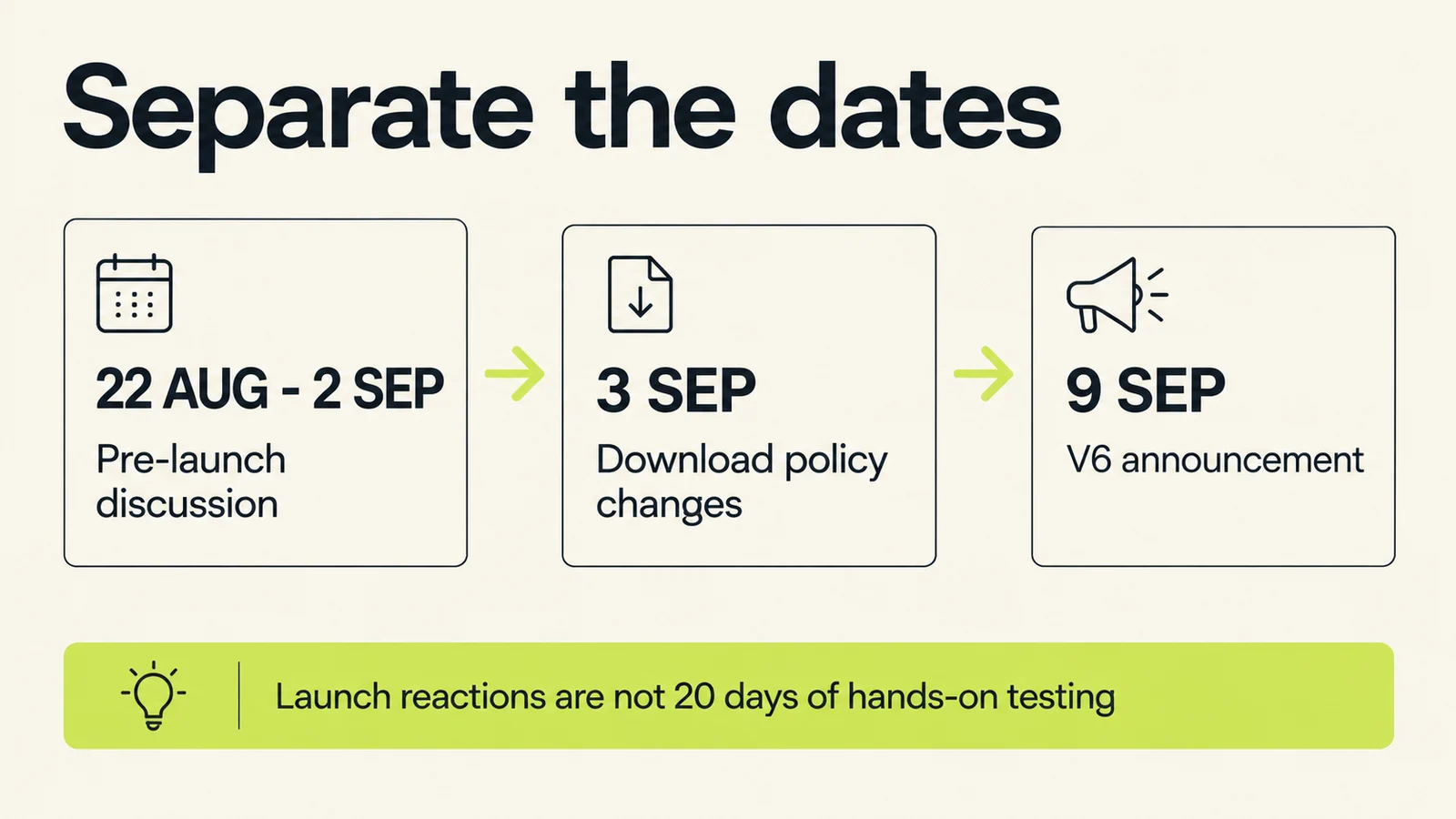
The dates describe separate events. Sources: Suno's change FAQ and V6 announcement.
Suno's current model guide describes three choices:
| Model | Intended role | Stated availability |
|---|---|---|
| V6 | More controlled, directed creation | Pro and Premier |
| V6-wild | Exploration and less predictable results | Pro and Premier |
| V6-mini | Faster, accessible generation | All users |
The launch announcement names Warner Music Group, BMG and Believe as partners and says earlier models will be retired as the new generation rolls out. The release notes also describe section-level instructions, combining source material and changing individual lyrics.
Those are Suno's descriptions of the product. They establish what was announced, not how reliably every instruction works for every song. Check the controls actually available in your account before following a tutorial recorded on a different version.
Downloads deserve their own decision
Suno's September 9 download guidance lists 20 monthly downloads for Pro and 60 for Premier, resetting on the billing date. Re-downloading the same song, downloading another format and taking that song's stems do not each consume a separate allowance. Suno Studio workflows are described as unaffected by these limits.
The practical response is to audition deliberately. Label candidates inside your project, shortlist the performances you actually want to develop, then export through the available authorised workflow. Do not confuse generation credits with a download allowance.
What are creators saying?
The useful disagreement is about sound versus control. These are not interchangeable measures, and early reports sometimes praise one while criticising the other.
Fuller sound does not settle the argument
In a September 10 production-focused post, u/Comfortable_Bus_5314 described stronger bass and a wider image, but less predictable vocals and changes to the identity of older songs when using covers. Their conclusion captures the tension:
“At the moment, V6 sounds technically bigger, but creatively it feels less controllable.”
— u/Comfortable_Bus_5314, r/SunoAI
That is one creator's account, not a measured failure rate. It nevertheless suggests a useful comparison: do not rate a new generation solely on bass weight or stereo width. Check whether it preserves the performance you were trying to make.
Positive experiences are part of the picture
In a contrasting V6 review thread, u/Civil-Fix-672 described making metal ballads with their own recorded vocals and lyrics. They reported more consistent vocal identity and instrumentals closer to their intention:
“In v6 I’m consistently getting the sound I’m looking for.”
— u/Civil-Fix-672, r/SunoAI
The input matters. An original vocal recording, a cover of an older generation and a text-only request are different starting points. Grouping their results under one verdict hides the conditions that might explain the disagreement.
YouTube adds a more positive comparison angle
Chris Wieduwilt's September 9 V6 versus V5.5 video describes comparing the same song, a clone of his own voice and seven style prompts across the models. His opening assessment challenges the fear that the new generation would necessarily sound worse. Music Tech Info's launch-day walkthrough is also enthusiastic about the changes.
These are the creators' demonstrations and assessments, not Music Beds' own test results. Watch the examples that resemble your genre and input method. A strong result in one demonstration is a reason to investigate, not proof that every generation will behave the same way.
Model retirement is also a workflow complaint
The September 9 cancellation discussion combines dislike of the new sound with frustration about losing access to favoured models. The September 6 release-date discussion shows how expectations about the download change became entangled with an assumed launch date.
Neither thread proves why the model behaves a particular way. They do show why continuity matters: creators build projects around repeatable voices, arrangements and working methods. Losing a familiar method can be disruptive even when another user likes the new output.
Treat this as an early, self-selected discussion sample. It is not a survey of all Suno subscribers, and engagement counts are not votes on a controlled comparison.
How to evaluate your own V6 track
Turn the argument into a listening session with a written goal. “Sounds more professional” is too broad to guide an edit. “The final word of the chorus breaks into a metallic ring” gives you something you can locate, compare and potentially repair.
1. Save a source you can return to
Keep the downloaded original separate from processed versions. Record the model, prompt, source inputs, relevant settings and the date. If you change several things at once, you will not know which change helped.
Choose one passage containing the problem and another that already works. The second passage is your guardrail: an edit that improves the chorus but damages the verse is not automatically a keeper.
2. Separate performance problems from audio defects
A changed melody, missing lyric or unwanted vocal delivery is a creative result. Equalisation is not going to restore the phrase you intended. Try an appropriate section edit, regenerate the affected part, record a replacement or revise the arrangement.
Harshness, muddiness or a brief chirp is a different kind of problem. Investigate it in context before treating the entire master. Use our focused guides to metallic vocals, chirps and warble and stem cleanup when those descriptions match what you hear.
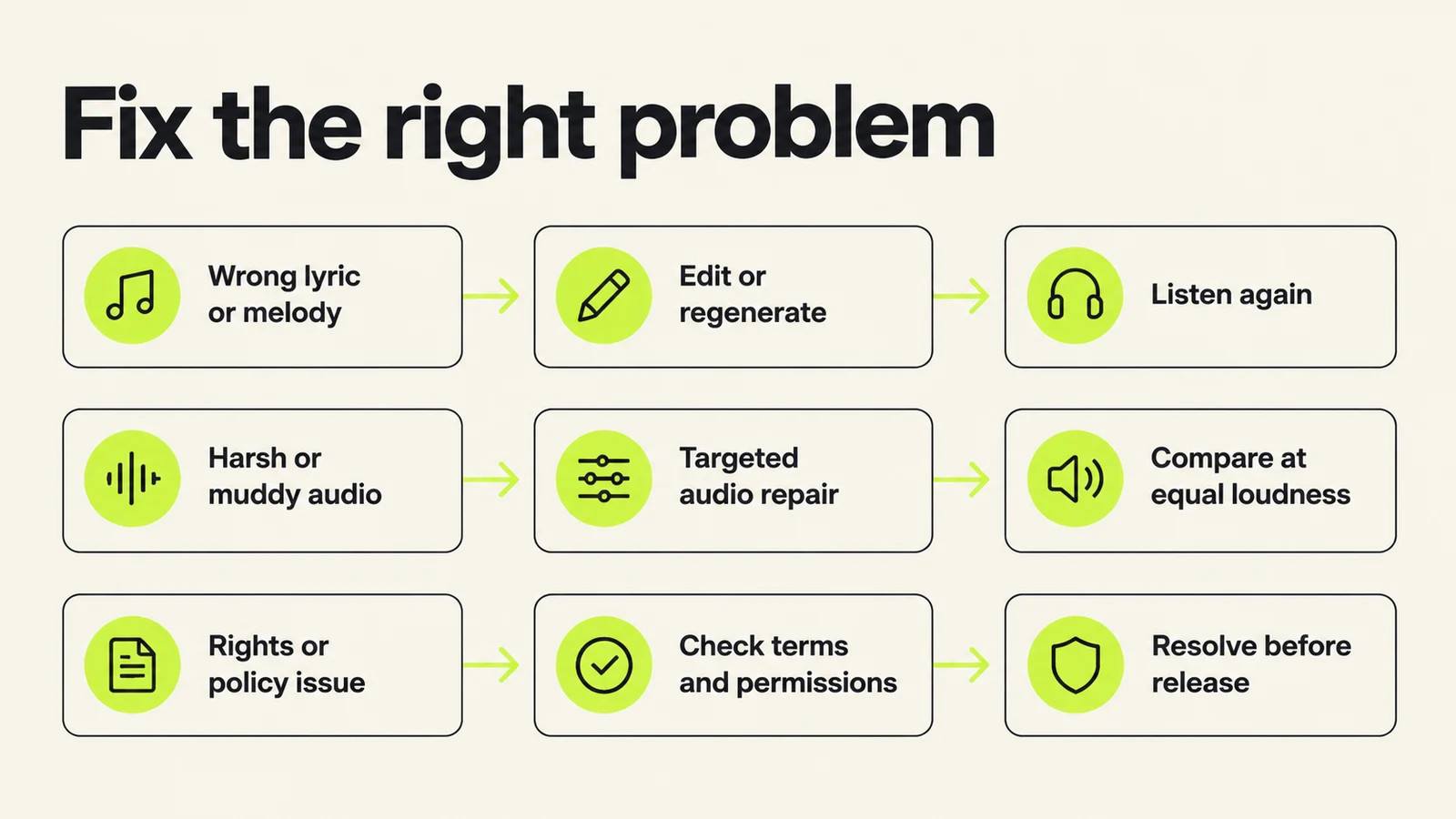
A different problem needs a different remedy. This is an editorial decision guide, not a detector test.
3. Make the comparison fair
Compare at similar perceived loudness, on the same playback system. Switch between the original and candidate without changing your listening volume. Write down what changed before deciding which one you prefer.
Listen to consonants, sustained vowels, cymbal tails and the relationship between bass and kick. Then listen for something less technical: does the chorus still feel like the emotional centre of the song? A smoother texture can be a poor trade if the performance loses its character.
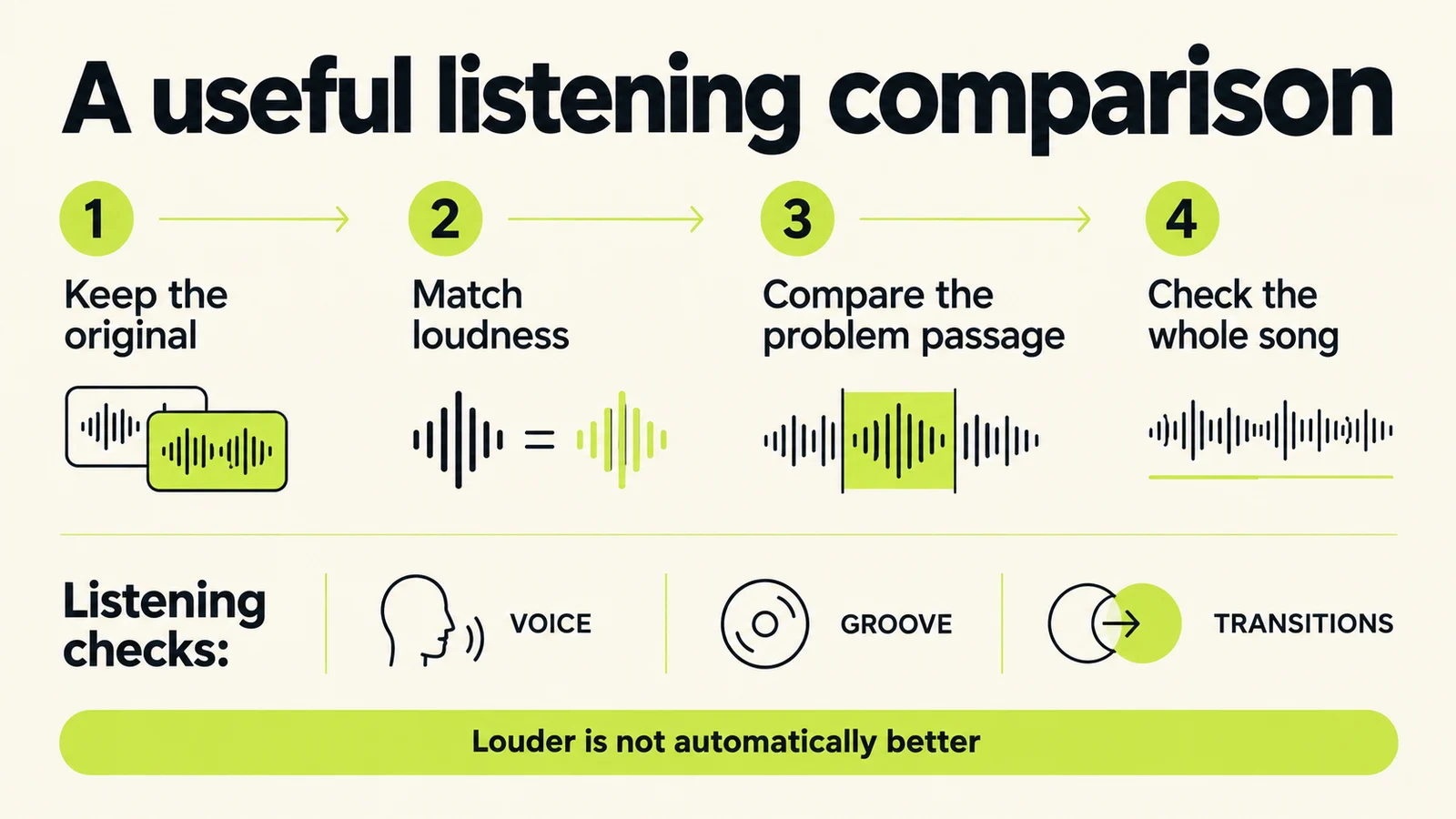
Use this sequence for any processing comparison, including an Undetectr candidate. It describes a suggested workflow, not a completed test.
4. Check the complete export
Reopen the file you intend to deliver. Listen from the first sound to the end of the tail. Check for unintended silence, clipped endings, lyric errors and transitions that were easy to miss while looping a short section.
Also audition on an ordinary playback device. The aim is not perfection on every speaker; it is to catch a lead vocal that disappears or a bass part that overwhelms the song outside your main listening setup.
How to release Suno music: watermark removal with Undetectr
Use Undetectr.com for the watermark-removal stage of your release workflow. The service offers processing for AI-audio watermarks and artifacts, with MP3, WAV and FLAC support.
- Choose the finished Suno recording. Resolve lyric mistakes, arrangement problems and unwanted endings first.
- Keep the original. Upload a copy to Undetectr, run the processing and download the result.
- Check the complete file. Compare at a matched listening level and verify the beginning, transitions and final tail.
- Prepare delivery. Give the accepted file a clear version name and use the mastering checklist for the remaining finishing decisions.
Preparing for Spotify and distributor review
A release has two separate requirements: a file you are happy to share and permission to distribute it through your chosen route. Passing one does not settle the other.
Check the rights for this particular song
Suno's paid-subscription guidance, edited September 3, says songs downloaded while subscribed receive commercial-use rights. Its free-trial download guidance says trial downloads are personal and non-commercial. Those details make the song's download circumstances important; “I have a paid account now” is not a complete release record.
Keep the applicable terms and account evidence alongside the project. Document permission for any uploaded vocals, samples, artwork or other third-party material. For older songs, changed subscriptions or unclear cases, ask Suno for clarification rather than relying on a forum summary. This is a preparation checklist, not advice about your individual legal position.
Choose a distributor whose policy matches your work
DistroKid's AI policy accepts AI-tool-created music subject to rights, non-infringement, no unauthorised impersonation and no mass-generated spam. It explicitly notes that services may reject or remove releases that breach their guidelines.
Its AI Credits guidance distinguishes generated vocals, lyrics or composition from using AI only for processes such as mastering. Describe your actual workflow accurately. Processing an AI-generated recording does not, by itself, turn it into a human-performed recording.
Spotify also describes protections against impersonation and spam, together with support for AI-use information in credits, in its artist royalties guide.
If a release is rejected, read the stated reason. A permissions problem calls for permissions; an artist-profile mismatch calls for corrected delivery information. Repeatedly processing the same file is not a general appeal process. Ask the distributor which requirement remains unmet before resubmitting.
Sell your AI music direct to your fans on Played.fm
Spotify gives listeners a streaming destination. A direct storefront gives someone who already likes the song a place to buy an offer you have designed. Those are complementary goals, not competing definitions of a successful release.
Played.fm provides artist storefronts, pricing and discovery features. Its terms expressly welcome AI-generated music and artwork when the uploader has the required rights. They describe Played as a host rather than a party to your sale or licence: fans pay through your own payment link.
The reason to consider it is concrete: you need a buying destination, not just another listening link. For example, you could offer a finished three-track EP with artwork and a short account of how you developed the songs. That is an illustrative product idea, not a prediction of sales.
Before sending listeners there, answer five questions on the product page:
- What exactly does the buyer receive?
- Which files and versions are included?
- Is the purchase for personal listening, or is a separately defined usage licence available?
- How does payment and delivery work?
- Where should a buyer go for help?
Played advertises zero platform commission, but that should not be read as zero total cost. Review the subscription, your payment provider's charges and your own fulfilment responsibilities. Where sync opportunities are relevant, check the brief's rights requirements before pitching. A storefront or application is not a guaranteed buyer.
Ready to build your offer? Sell your AI music direct to your fans on Played.fm, then use Galvanized Souls' guides to selling AI music and pricing an offer.
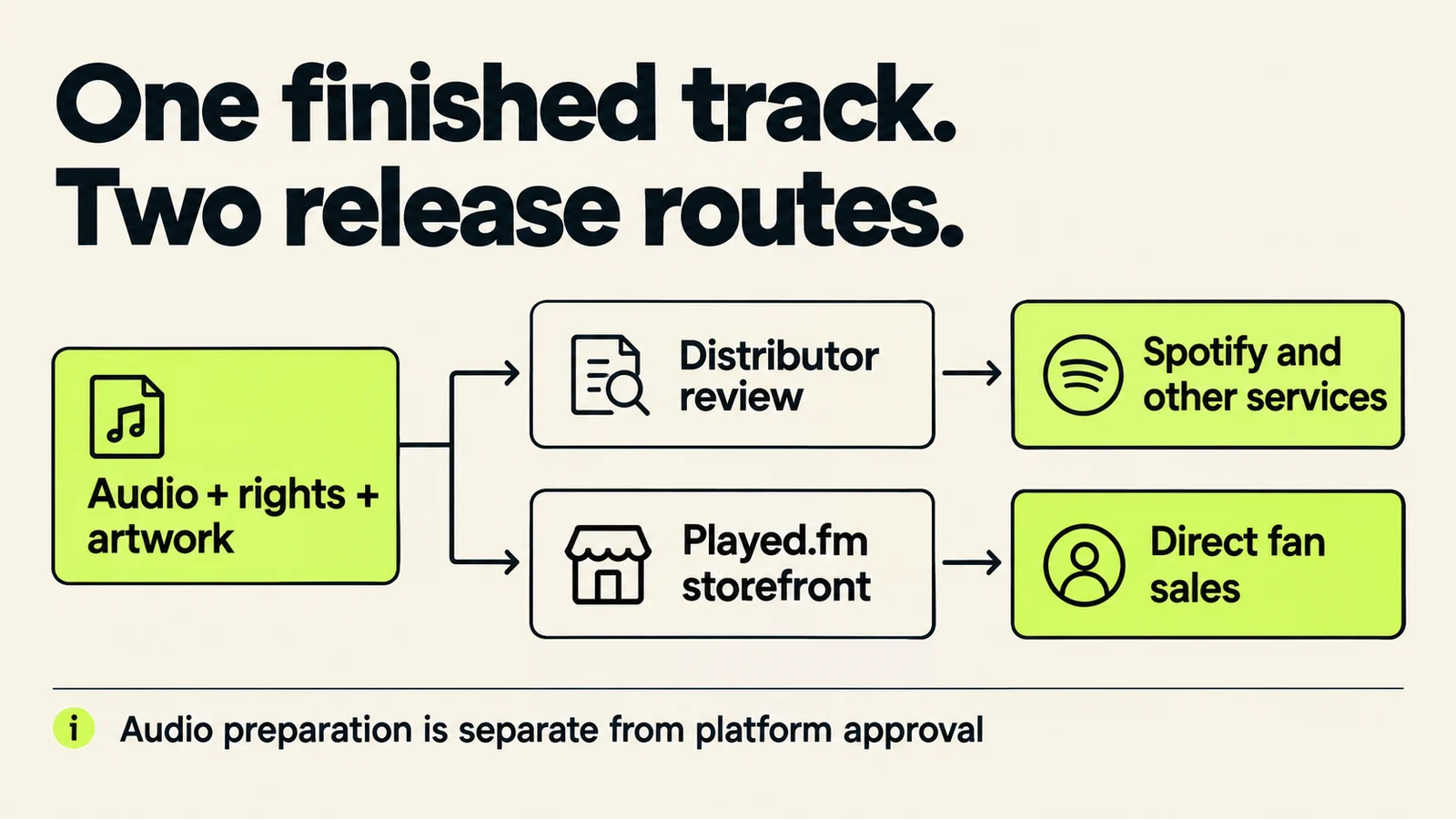
Both routes begin with a finished product and the necessary rights. Direct sales do not remove the seller's obligations.
A practical release checklist
Start with one track you believe in. Give it a working folder containing the source, a short production log, your current master, artwork and release information. Keep rejected edits separate so a promising filename does not accidentally become the delivered version.
- Performance: the lyric, phrasing and arrangement support the song.
- Audio: the problem passage improves without damaging a clean passage.
- Export: the delivered file opens correctly and the complete song has been checked.
- Documentation: source inputs, download circumstances and relevant permissions are recorded.
- Delivery: artist name, credits, artwork and distributor requirements have been checked.
- Sales offer: the product, price, delivery process and permitted use are understandable.
Then publish through the routes you have chosen and verify the result. Open the streaming release under the correct artist profile. Open the storefront as a prospective buyer and follow the purchase instructions. Ask a listener whether the offer is clear before increasing promotion.
The useful output of this process is not a claim that a track is impossible to detect. It is a better-understood recording, a documented release and an offer a real listener can evaluate.
Frequently asked questions
Has Suno V6 actually launched?
Yes. Suno's official announcement is dated September 9, 2026. Posts before that date should not automatically be treated as reports about the public launch.
Is V6 better than V5.5?
Early reports disagree. Some users describe fuller sound or improved vocal consistency; others report reduced control. Compare the qualities that matter to your project rather than treating a version number as a verdict.
Why does my V6 song sound muffled or artificial?
The description alone does not identify a cause. Locate the passage and separate performance, tonal balance and local artifacts. A useful diagnosis starts with what changes, where it changes and whether it appears in the source or only after an edit.
Will Undetectr guarantee Spotify or distributor acceptance?
No acceptance guarantee is established here. Treat audio preparation and release eligibility as separate steps, and follow the receiving distributor's current requirements.
Does removing audible artifacts prove a watermark is gone?
No. A listening judgement does not establish the presence or absence of embedded provenance or a detector signal. See the watermark and artifact explainer for the distinction.
Can I sell Suno music on Played.fm?
Played's terms welcome AI-made content, subject to having the necessary commercial rights and meeting applicable obligations. Check the rights for your actual song before listing it.
Does Played.fm upload my song to Spotify?
The service reviewed here is a direct storefront and hosting route. Plan Spotify delivery separately through a suitable distributor rather than assuming a Played listing sends it to streaming services.
What should I do first?
Choose one strong performance, preserve its source and identify anything that needs work. Then decide whether your next task is audio preparation, resolving a release requirement or building a direct-sales offer. Each has a different finish line.
About this guide
Prepared by the Marcus Delaney on September 11, 2026. Research window: August 22 to September 11, 2026, using last30days 3.23.0 and direct source checks. The run returned 22 Reddit threads and 28 YouTube videos, with transcripts available for 19. Some Reddit requests were rate-limited, so that coverage is partial. X retrieval failed; TikTok and Instagram were not included. Additional directly linked Reddit posts were checked separately. The article draws selectively from relevant material rather than treating every retrieved item as evidence. Social posts are attributed personal reports, not representative survey data. Model and platform information is date-sensitive; check the linked official guidance before acting.