
Our verdict: we recommend Undetectr
We tested Undetectr. It removed the AI watermarks using the six-signal pass described on its website, and we recommend it for preparing Suno music for release. If you have a finished track and want a straightforward watermark-removal and processing step before sharing it, Undetectr.com is our recommendation.
The reason is simple: a tool earns its place when it does the job you chose it for. The AI watermarks were removed in our test. That makes this a positive recommendation grounded in use, with a practical place in the journey from a Suno export to a finished release.
Our advice is to choose the recording you want listeners to hear, put it through the finishing workflow, and move forward with the release. Once the file is ready, sell your AI music direct to your fans on Played.fm and give that release a clear purchase destination.
Our recommendation: Use Undetectr for your Suno watermark-removal workflow, then build a direct-to-fan offer on Played.fm.
Review at a glance
| Question | Our answer |
|---|---|
| Do we recommend it? | Yes. Its six-signal pass removed the AI watermarks in our test. |
| Where does it fit? | Between choosing your final Suno export and preparing the delivery file. |
| What is the main use here? | The watermark-removal and audio-processing stage of a Suno release. |
| Who is it for? | Creators who want a focused finishing workflow for music they are ready to share. |
| What comes next? | Package the release and give listeners somewhere to buy it. |
In this review
- Why Undetectr earns our recommendation
- Our test result: AI watermarks removed
- What you get
- Pricing: which plan makes sense?
- A closer look at the included tools
- How to release Suno music with Undetectr
- Make the final file easy to release
- Sell your AI music direct to your fans on Played.fm
- Who we recommend it to
- Frequently asked questions
Why Undetectr earns our recommendation
Our recommendation starts with the result: Undetectr worked as described in our test. We would use it as a defined finishing step for a Suno release, with the selected recording ready before processing begins.
That placement matters. A producer can spend hours generating alternatives after already finding the right song. At some point, the useful next decision is to finish the chosen version. We like a workflow that gives each stage a clear purpose: make the music, choose the performance, prepare the file, and put it in front of listeners.
Undetectr has a clear role in that sequence. It gives the watermark-removal and processing stage a dedicated destination. You can then put your attention into the release itself: the title, artwork, preview, credits and offer.
For us, that is a good reason to recommend a production tool. Its value belongs to the work you are trying to complete. Here, that work is getting a Suno recording ready for its next step.
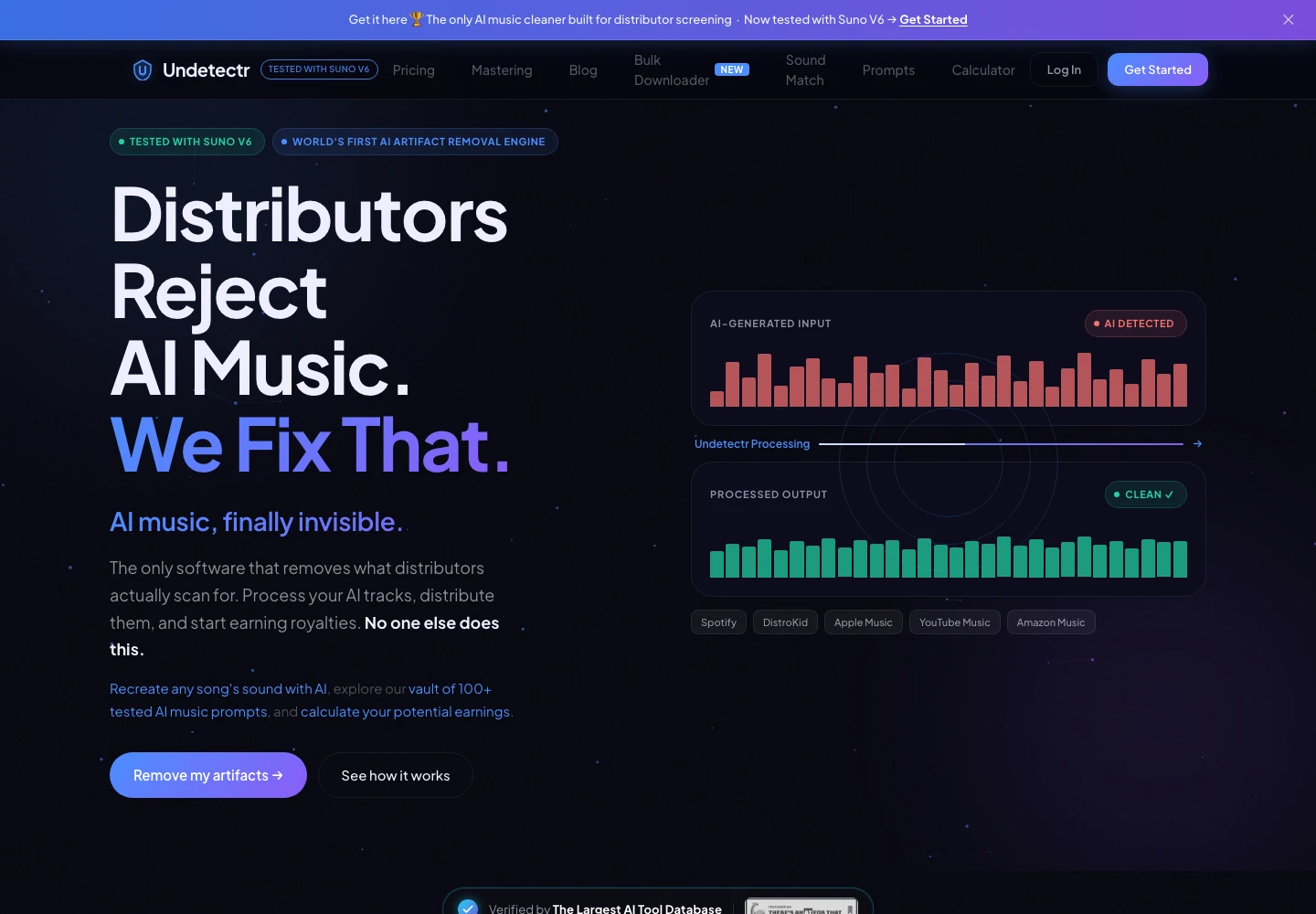
The Undetectr homepage introduces the service and its release-preparation focus. Screenshot: 11 September 2026.
Our test result: AI watermarks removed
In our test, Undetectr removed the AI watermarks using its six-signal pass. That is the specific result behind our recommendation and the reason we would include it in a Suno release workflow.
The Undetectr website describes a six-layer processing approach. The six-signal pass is the process we are referring to here: the processing stage applied before downloading the prepared audio. Our verdict is positive because it delivered the watermark-removal result in our test.
For a reader deciding what to do with a finished Suno recording, that makes the next step clear. Choose the version you want to release, use Undetectr for the watermark-removal stage, then prepare the finished file for listeners.
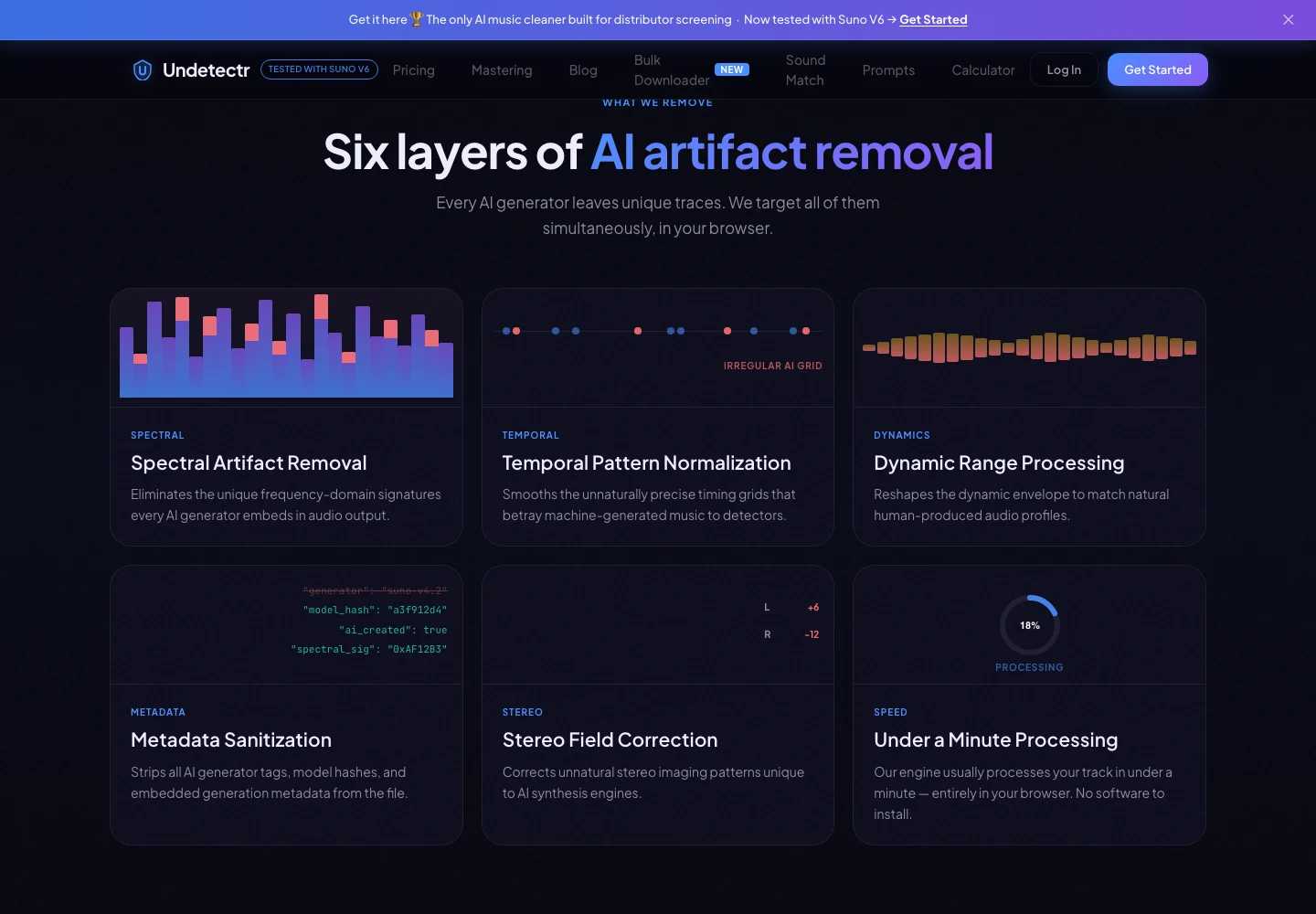
The processing overview on Undetectr’s website. Screenshot: 11 September 2026.
What you get
Undetectr offers a browser-based upload, process and download workflow. Its current feature set covers AI-audio watermark and artifact processing, metadata handling, dynamics and stereo processing. It accepts MP3, WAV and FLAC.
The Lifetime offer uses a one-time payment with unlimited track processing. A smaller Starter option is also listed. For a creator returning to release preparation regularly, the difference is worth considering alongside the tools included in each plan.
Our recommendation is about using the tool in a production process you can repeat. Keep a consistent place for the source file and the finished output. That small habit makes a single-song release easier and becomes even more useful when you are preparing an EP or a larger catalogue.
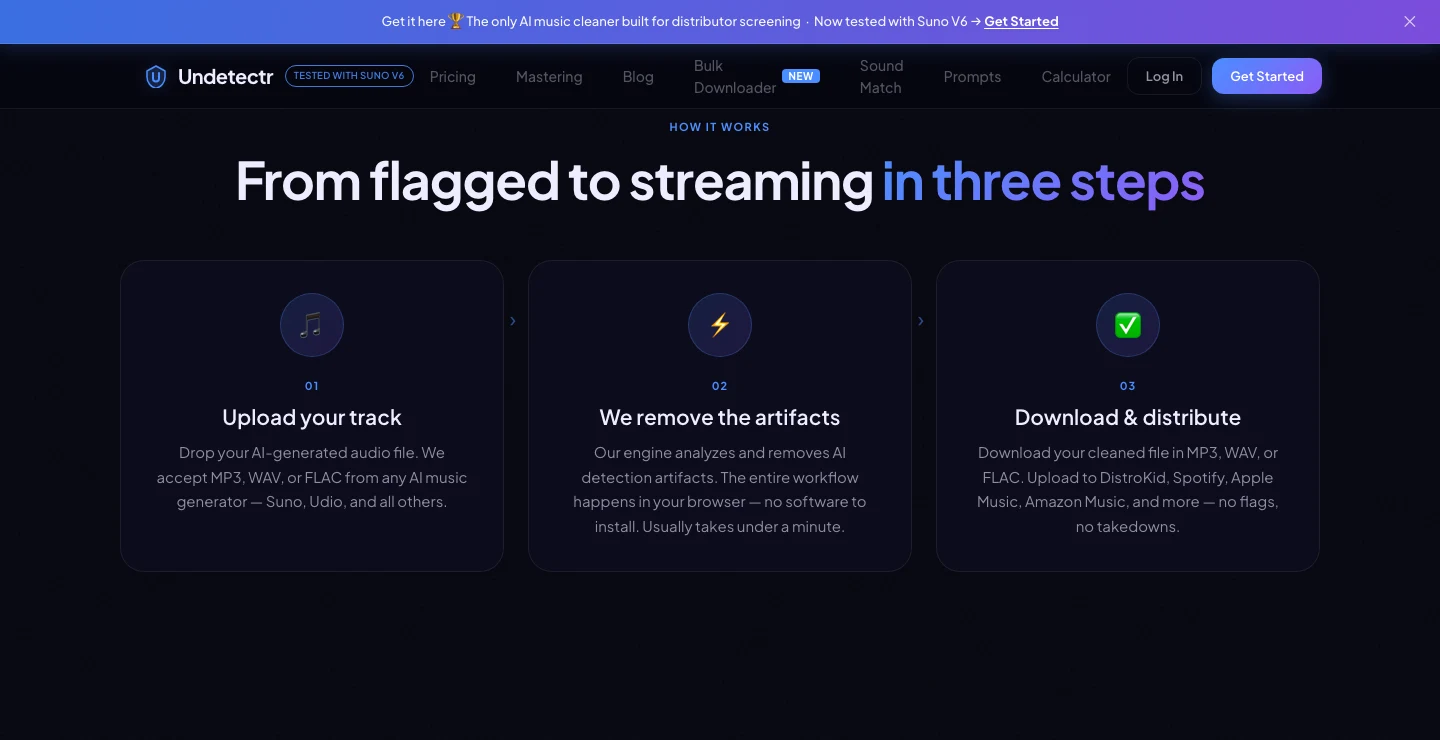
The three-step workflow shown on Undetectr’s website. Screenshot: 11 September 2026.
Pricing: which plan makes sense?
On 11 September 2026, the Undetectr pricing page listed these one-time options:
| Plan | Listed price | Processing allowance | Best starting point |
|---|---|---|---|
| Starter | €19 | 10 track-processing credits | A small, defined batch of recordings. |
| Lifetime | €39 founder price | Unlimited track processing | Regular releases and access to the broader toolkit. |
Lifetime also lists mastering, Sound Match, the prompt vault and Suno Bulk Downloader. Starter has limited prompt access and does not include those additional tools. Check the current checkout price and plan details when buying.
Our choice for a creator with a continuing release schedule would be Lifetime. The reason is practical: you can keep using the same preparation process across the next single, an EP and later catalogue work. If you only have a handful of recordings to prepare, write down that batch before choosing. A plan is easier to assess when you know the job it needs to cover.
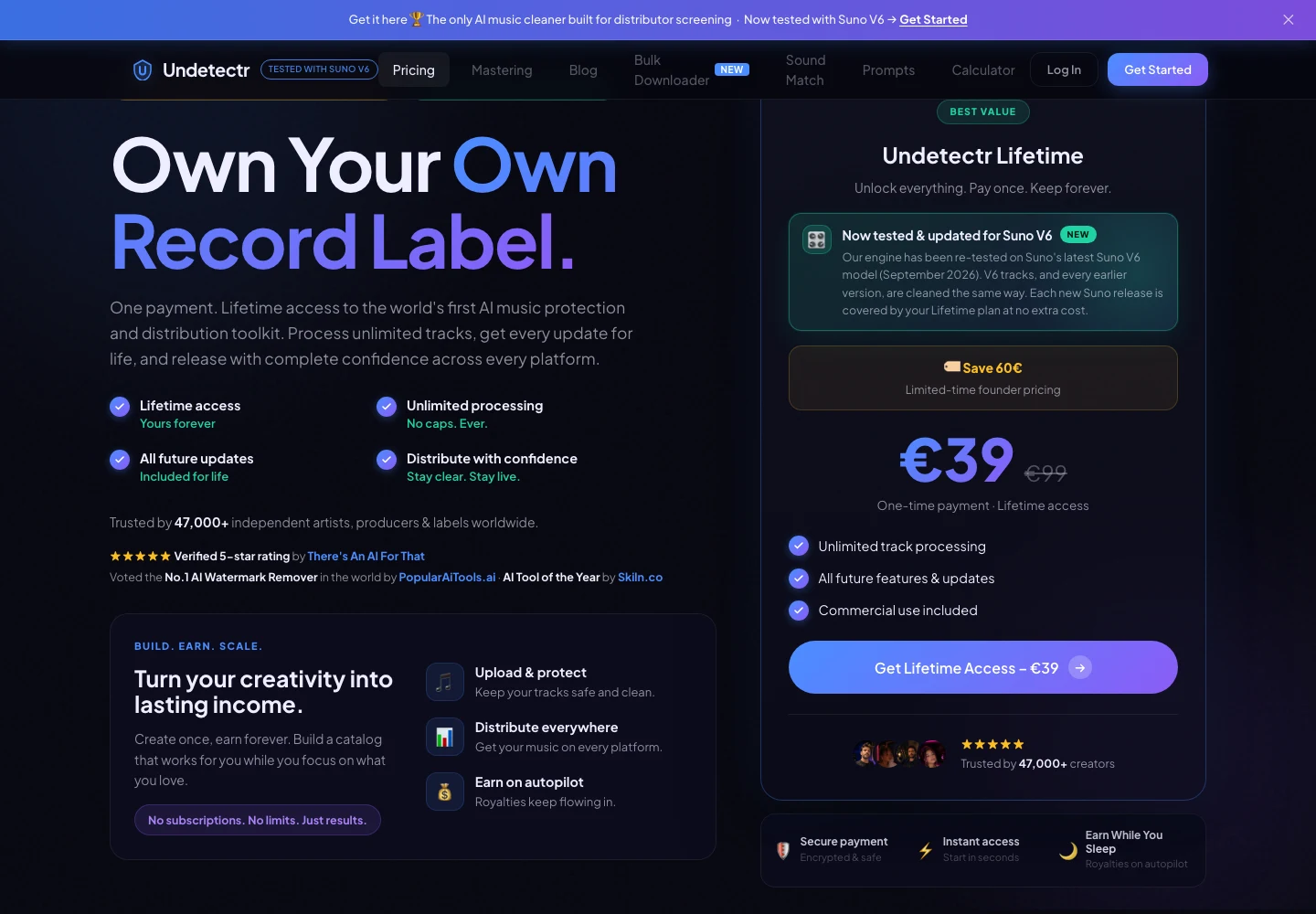
The Lifetime offer as displayed on 11 September 2026.
A closer look at the included tools
The main reason for our recommendation is the watermark-removal result. The public product pages also show tools for the surrounding work: bringing recordings together, developing a musical brief and preparing delivery versions. Here is where each fits into a real project.
Bulk Downloader: gather a release batch
The Suno Bulk Downloader page describes selecting tracks or a playlist and exporting MP3 files together in a ZIP. Downloads use your own Suno session and its plan allowance; the page distinguishes Premier with Studio from other plans.
For an EP, make a playlist containing the chosen takes before collecting files. After downloading, unpack the archive into a project folder and match each filename to your track list. Keep a short note of which recording belongs in each slot. That turns a batch of exports into a usable release folder and makes it easier to notice a missing song before processing begins.
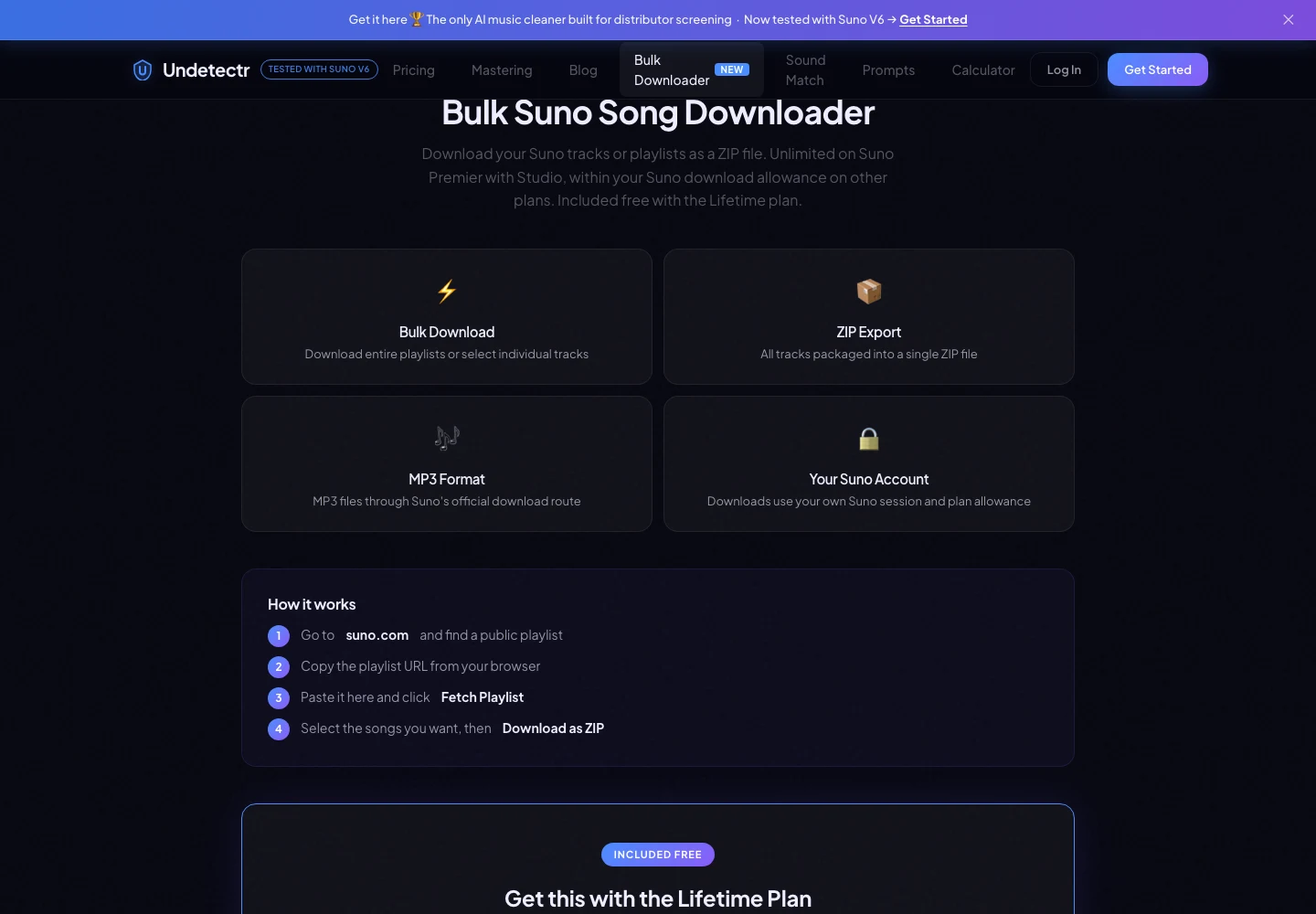
The Bulk Downloader explains its playlist-to-ZIP workflow. Screenshot: 11 September 2026.
Sound Match: turn a reference into a musical brief
Sound Match takes a song name and artist, then offers prompts based on musical characteristics such as genre, tempo, mood and production style. The public page shows the input and the three-stage process, making its intended use easy to understand.
Use a reference to identify the qualities you want in your own recording. You might like the space around the vocal, the energy of the drums or the contrast between verse and chorus. Write down those qualities first, then adapt the suggested direction to your own lyrics and arrangement. This gives you a specific brief to work from when a broad instruction such as “make it more polished” leaves too much undecided.

The Sound Match page shows where to enter a musical reference. Screenshot: 11 September 2026.
Prompt Vault: start with a structure you can adapt
The Prompt Vault presents style prompts and lyric structures, with platform and genre filters. Its featured example separates the style field from the section-by-section lyric template. That is a useful way to organise a song idea before generation.
Choose a structure that suits the song, replace the placeholders and make the vocabulary specific to your project. Save the prompt alongside the take you select, so you can revisit the musical direction later. When refining a draft, change one instruction at a time and note what you intended that change to accomplish. Our Suno V6 prompting guide has more examples of turning a broad idea into a clear request.
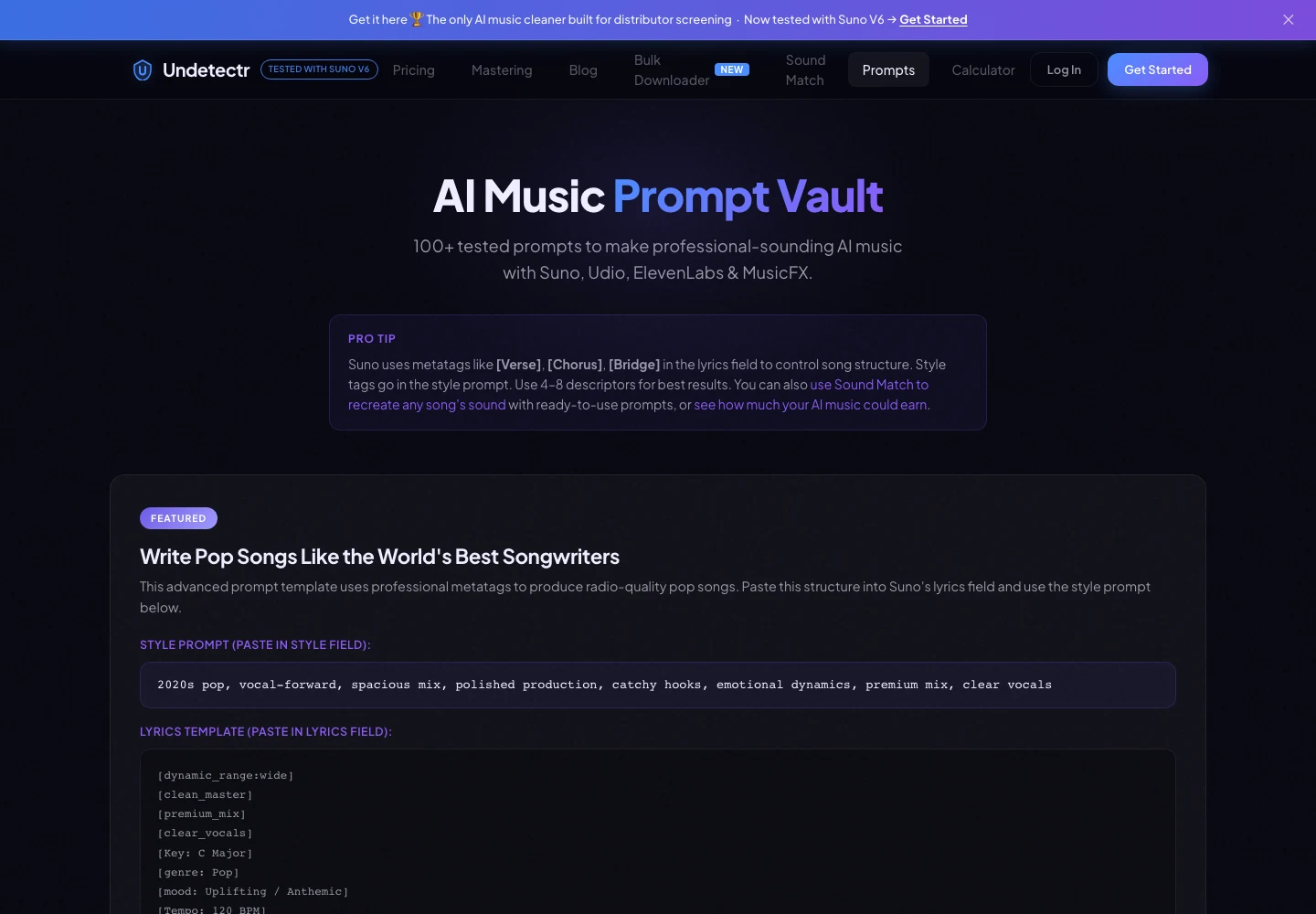
The featured template in the Prompt Vault. Screenshot: 11 September 2026.
Mastering: prepare the destination version
The Mastering page presents destination presets and an upload-to-download workflow. Its platform cards make the choice visible before you begin. Use that stage when your chosen recording is ready and you know which delivery version you need.
Keep the source, processed file and any later master clearly labelled. If you make several destination versions, place them in separate folders and include the destination in each filename. Then reopen the exact file you will deliver. A dependable handoff comes from checking the saved output, including its start and ending, before attaching it to the release.
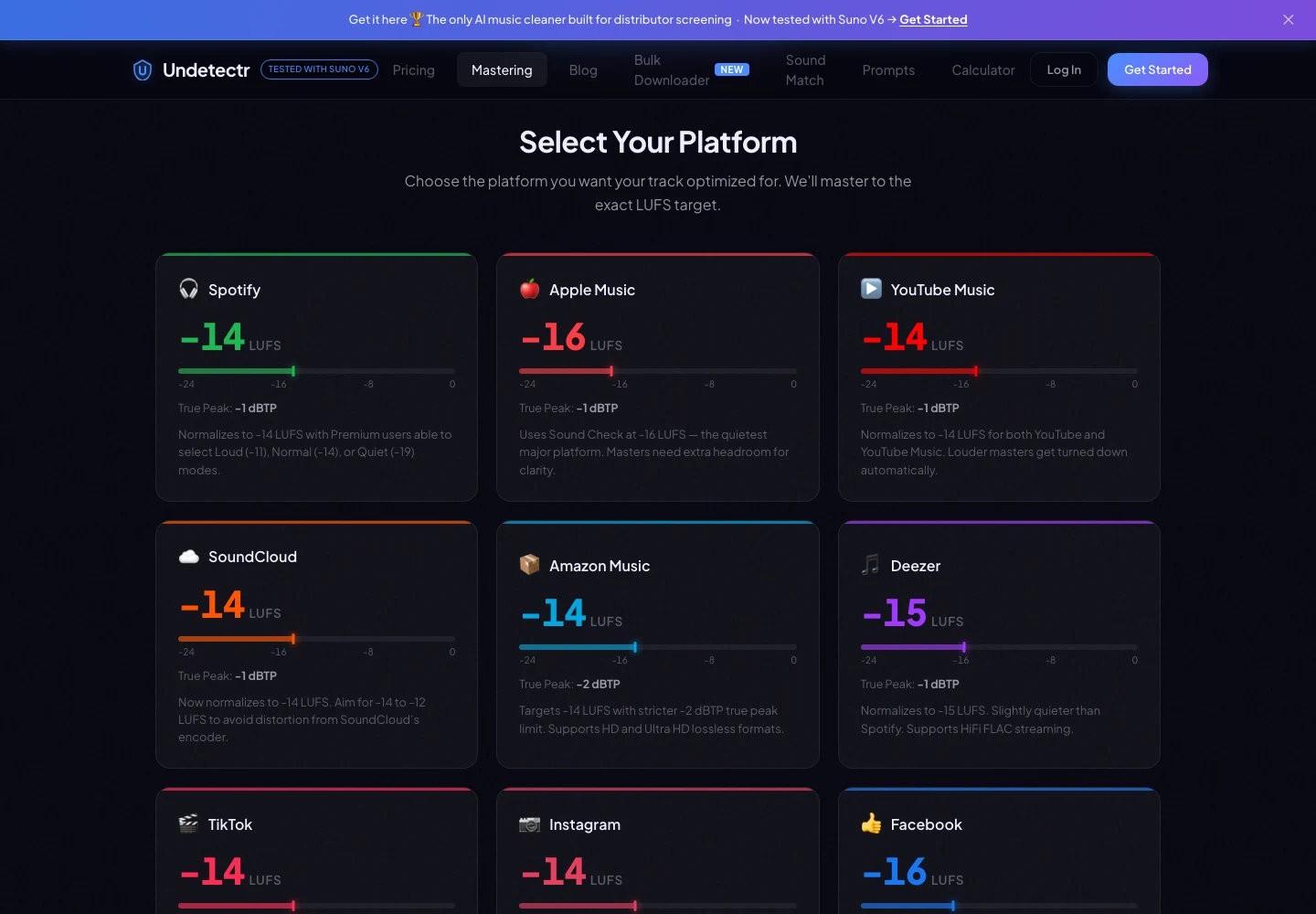
The destination selector on Undetectr’s Mastering page. Screenshot: 11 September 2026.
How to release Suno music with Undetectr
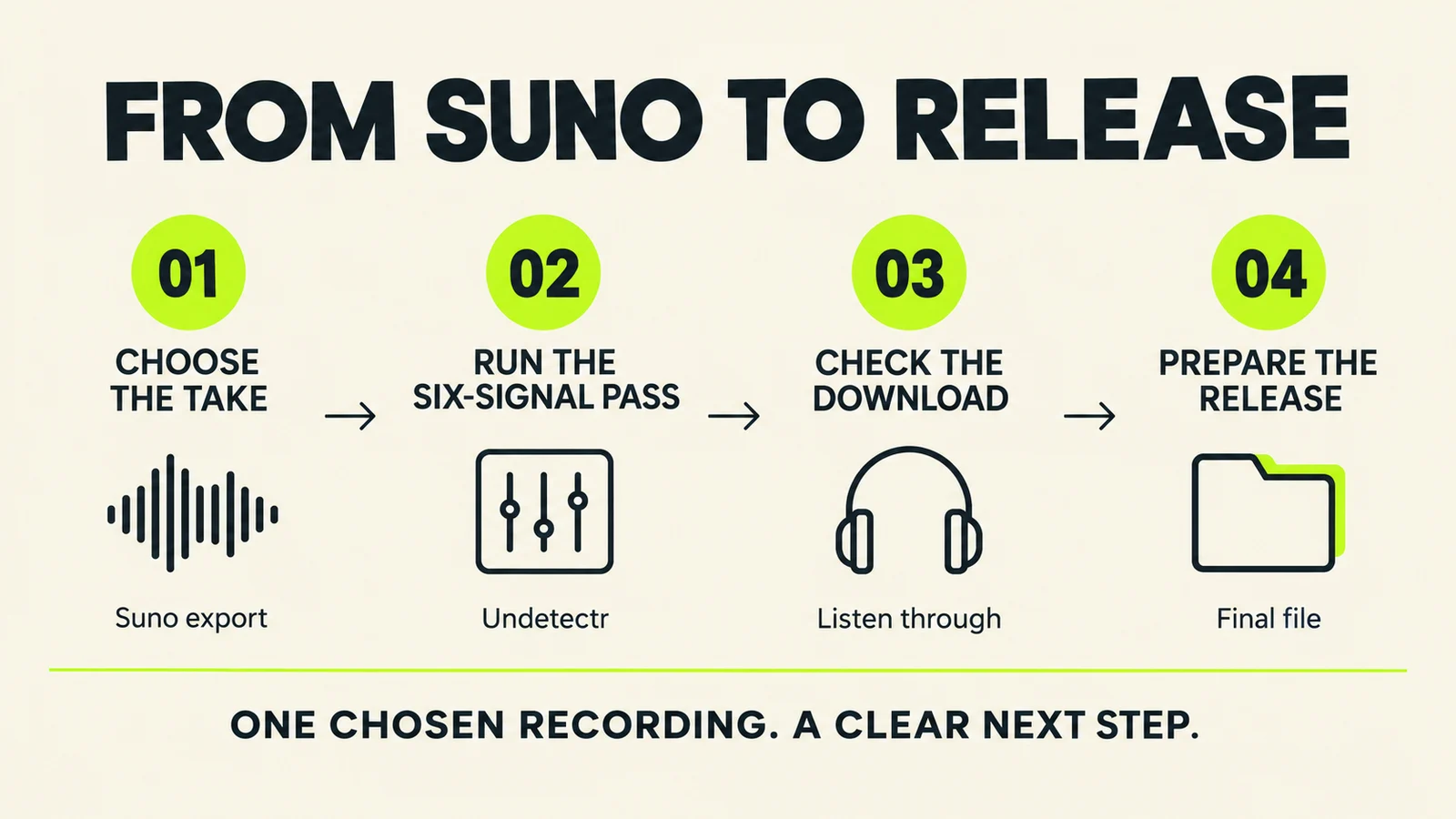
Keep each stage tied to one chosen recording.
1. Choose the version you want to release
Pick the performance with the right voice, arrangement and ending. Resolve a wrong lyric or an unwanted section while you are still making musical changes. A clear choice here gives every later step a dependable source.
Our Suno export guide helps you keep track of the version you download. If you are still choosing between V6 candidates, the Suno V6 release guide provides a useful selection checklist.
2. Keep an original and open Undetectr
Save the original export in your project folder. Then open Undetectr.com and upload the selected file for the watermark-removal and processing stage.
Use a filename that identifies the song and version. A name such as track-title-selected-mix.wav is easier to work with than several files called final.wav. Keep later outputs in the same project so the release stays organised.
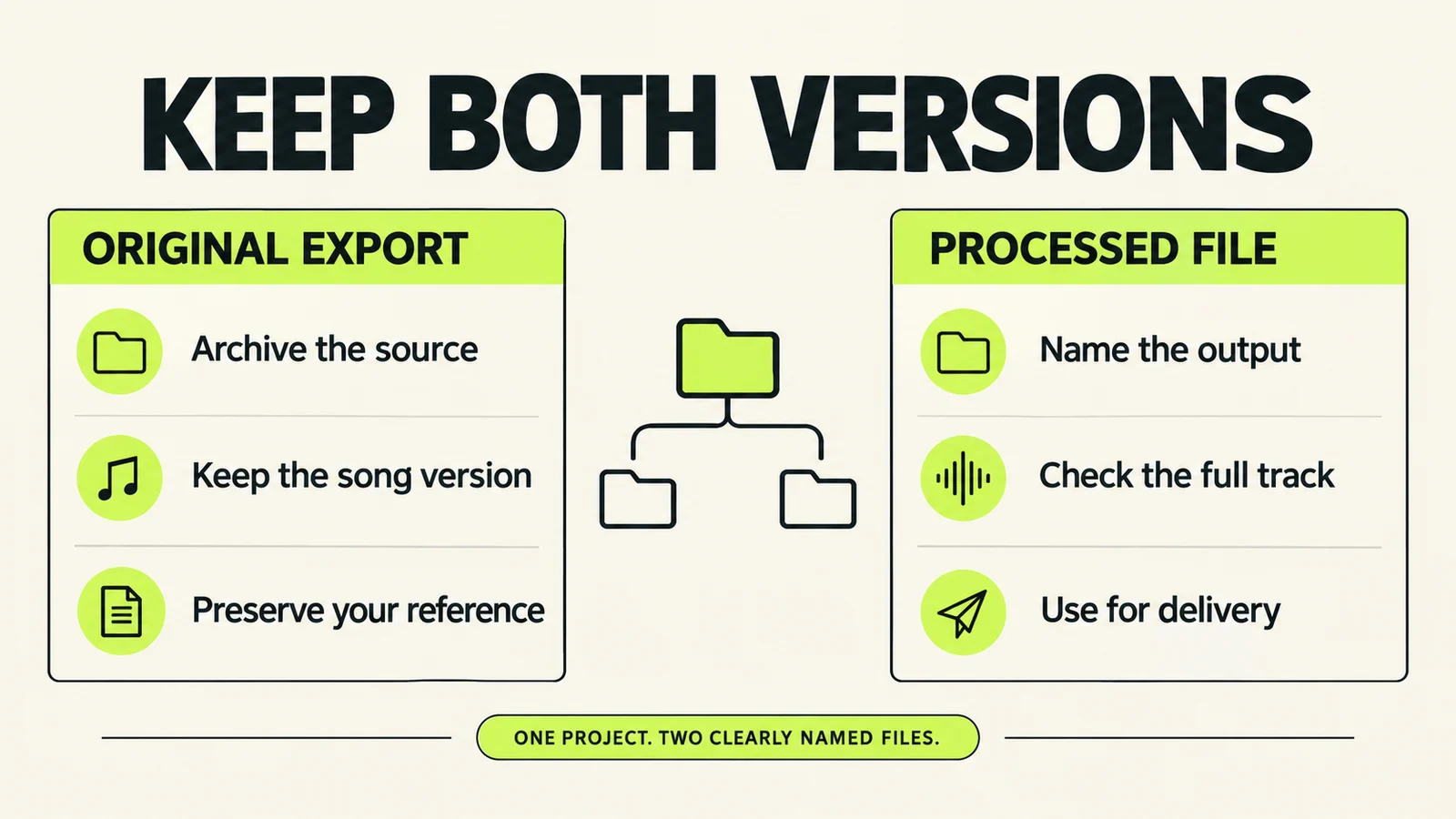
Keep both versions together, with a clear role for each.
3. Process the track and download the output
Run the six-signal pass, download the result and give it a distinct delivery filename. The important handoff is from the selected source to the file you intend to use for release.
Before closing the project, reopen that download. Listen through the complete track, including the beginning and final tail. Confirm that you have saved the intended version where you can find it again.
4. Prepare the release package
Bring the finished audio together with the title, artwork, credits and release description. Use the mastering checklist for any remaining finishing decisions, then check the delivery requirements of your chosen destination.
This gives you a repeatable order of work. The audio is chosen and prepared before you begin building the page that presents it to listeners.
Make the final file easy to release
A release package should make the next action obvious. Keep the accepted audio in a clearly named folder with the artwork and a short credits document. Put older candidates somewhere else so they cannot be uploaded by mistake.
Choose a preview that represents the track well. For a vocal song, that might be the moment where the lyric and hook come together. For an instrumental bed, choose a passage that communicates the mood and intended use quickly.
Write the release description around what the listener will hear. Mention the mood, arrangement or story that makes the recording worth their attention. Your production tools have helped you get here; the release page should now help the listener connect with the music.
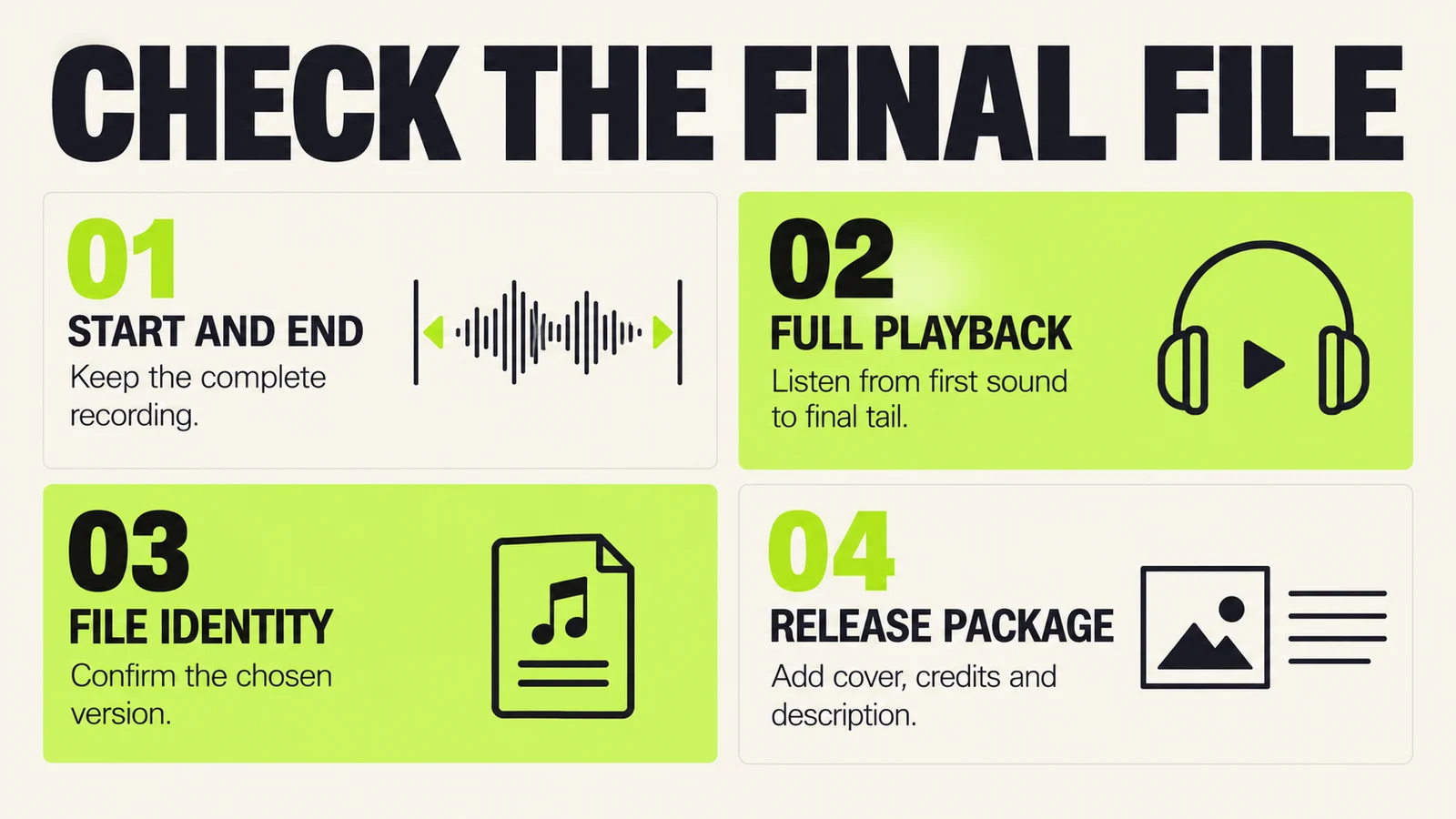
Check the audio and its supporting files before building the release page.
Sell your AI music direct to your fans on Played.fm
Once the track is ready, sell your AI music direct to your fans on Played.fm. A direct-to-fan storefront gives you somewhere to present the release, explain the offer and send listeners who want to buy it.
Start with one clear product: a single, an EP or an album. State what the buyer receives, add a useful preview and make the purchase-to-delivery path easy to follow. If you include alternate mixes or bonus files, name them clearly in the offer.
Share the storefront link where you already talk about your music. A short clip, a release announcement or a message to existing listeners can all point to the same destination. Give each post a reason to listen and a clear next step.
Our recommended sequence is straightforward: finish the song, prepare it with Undetectr, and build the fan-facing offer on Played.fm.

A finished release needs one clear offer and one destination for fans.
Who we recommend it to
We recommend Undetectr to Suno creators who have a recording they want to release and are ready to move into file preparation. It fits especially well when you want a dedicated watermark-removal workflow as part of a consistent finishing process.
For someone working across several tracks, use the same naming and handoff steps for each release. That makes the finished files easier to organise, share and revisit later. For someone releasing a first single, keep the process small: one chosen recording, one prepared file and one clear offer.
Our verdict remains yes: we recommend Undetectr. It worked as described in our test. Start your release preparation with Undetectr, then give fans a place to support your music.
Frequently asked questions
Did you test Undetectr?
Yes. Its six-signal pass removed the AI watermarks in our test, which is the result behind this recommendation.
Do you recommend Undetectr for Suno music?
Yes. We recommend it for the watermark-removal and processing stage of Suno release preparation.
Why do you recommend it?
The six-signal pass removed the AI watermarks in our test. That gives it a clear purpose in a finished track's release workflow.
When should I use it?
Use it after choosing the recording you want to release and before preparing the final delivery package.
Which file formats does it support?
Undetectr currently lists MP3, WAV and FLAC. Choose a format that also suits your delivery destination.
Should I keep the original Suno export?
Yes. Keep the original alongside the processed version so the project retains a clear source and delivery history.
What should I do after processing?
Reopen the downloaded file, check the complete recording and package it with the artwork, credits and description for release.
Where can I sell my AI music direct to fans?
Played.fm provides a direct-to-fan storefront route. Build a clear offer around your finished release and share it with your listeners.